JSON Configuration
The configuration a simple JSON object containing the complete description of the behavior of the CEP engine (a set of EPL statements) and the mapping between the NGSI Context Entities and CEP Events.
Here is an example:
{
  "host":"http://localhost:8080",
  "in":[
    {
      "id":"RoomX",
      "type":"Room",
      "isPattern": false,
      "attributes":[
        { "name":"temperature", "type":"double" },
        { "name":"floor", "type":"string" }
      ]
      "providers":[
        "http://localhost:8081"
      ]
    }
  ],
  "out":[
    {
      "id":"FloorX",
      "type":"Floor",
      "attributes":[
        { "name":"temperature", "type":"double" }
      ]
      "brokers":[
        { "url":"http://localhost:8081" }
      ]
    }
  ],
  "statements":[
    "INSERT INTO Floor SELECT floor as id, avg(temperature) as temperature FROM Room.win:time(10 min) GROUP BY floor OUTPUT LAST EVERY 10 sec"
  ]
}
Host url
The host url defined the HTTP address (scheme, host and port) where the Cepheus-CEP can be contacted.
It is used to subscribe to Context Providers (see next section).
Incomming events
The in array defines the list of incoming events (NGSI Context Entities) the CEP expects as input from Context Providers.
Each Context Entity must be defined by:
id: the ID of the Context Entity, can be a patten ifisPatternistrue, mandatory.type: the type of the Context Entity, mandatory.isPattern: if theidis a pattern, optional, default:false.attributes: the list of Context Attributes to match, mandatory, cannot be empty.providers: the list of Context Provider to subscribe for this Context Entity, optional.
Each Context Attributes must be defined by:
name: the name of the attribute, mandatory.type: the type of the attribute, mandatory. Only simple types are supported for now :string,double,float,int,bool.metadata: the list of attribute Metadata (withnameandtypeproperties like attributes).
There is two ways Context Providers can notify the CEP:
- The simplest way for the Context Provider is to send
/updateContextrequests to the CEP.
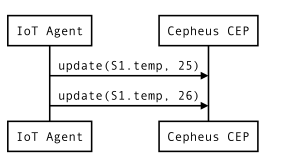
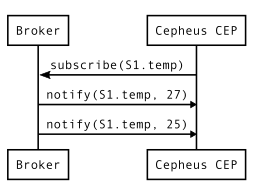
- The second way is to make the CEP subscribe to the Context Provider (like a Broker).
For each Context Provider defined in the "providers" field of an event, the CEP will send initialy a
/subscribeContext, and will expect in return the Context Provider to notify it with/notifyContextrequests.
Outgoing events
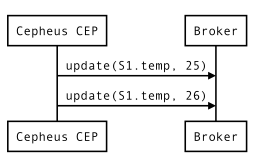
The out array defines the list of outgoing events (those generated by the CEP). Each outgoing event can have multiple brokers.
For each broker, the CEP will trigger ngsi10/updateContext requests to the broker on each event update.
Statements
The statements array defines a list of Esper EPL statements
that will interact with the events previously defined.